How Keith Alexander blazed a trail for black football managers
Özet haber: Ex-players and family members on the legacy of the late Lincoln, Peterborough and Macclesfield boss.
Listen to Keith Alexander: the man, the manager, the pioneer, on BBC Sounds
When Keith Alexander died in 2010, he was honoured up and down the country, including on one of football's biggest stages as England players donned black armbands for a match at Wembley.
It was a fitting tribute to a man who was not only an admired and respected figure in the game, but a trailblazer who helped pave the way for more black managers in English professional football.
As part of Black History Month, those who knew him best have been reflecting on his lasting impact.
"Keith remains a beacon of hope for us all, and I know his story continues to inspire us," says Leon Mann, a co-founder of the Football Black List, external, which gives out an award in his memory.
"When we see a number of black British or black managers in the Premier League, we should pause and remember Keith's contribution, because it would have played its part, one hundred per cent."
Matt and Paul Alexander say their father's caring nature meant he got the best out of players
Although he was not the first permanent black manager in the Football League – Tony Collins took the reins at Rochdale in 1960 – Alexander helped inspire a new generation to follow in his footsteps after spells in charge of Lincoln City, Peterborough United and Macclesfield, among others.
Born in Nottingham in 1956 to St Lucian parents, Alexander was proud of his English upbringing and Caribbean heritage, his sons Matt and Paul say.
Alexander spoke openly about the racism he encountered as a player, which included monkey chants and bananas being thrown at him.
"He experienced loads of it, especially in his early days," Matt says. "There was loads of racism and throwing bananas, that kind of stuff.
"I'd be really surprised if you spoke to any black footballer of that generation who hadn't experienced the same sort of thing."
Despite this, Paul says race was rarely discussed at home.
"It was never a conversation about how difficult it was for black youths growing up.
"It was, you will be successful at what you do and you work hard for what you want."
However, he adds: "I think he was conscious he did have to work twice as hard."
Former Lincoln striker Franny Green says he owes a lot to Alexander
After a long playing career, Alexander took charge of Lincoln City in 1993. After a season in charge, he went on to manage non-league Ilkeston Town and Northwich Victoria.
In 2002, he was named Lincoln boss for a second spell and, working with a tight budget, helped guide the club from the depths of administration to the League Two play-off places in four successive seasons.
Former striker Franny Green says Alexander will always be remembered for "bringing players from non-league and giving them an opportunity".
"If you go through Lincoln's history, Keith's name is going to be one of the biggest when it comes to what he did."
Green recalls having a real affinity with Alexander. "I think it helped because of my race and Keith's race," he adds.
Recalling the first time he met Alexander during a trial at Ilkeston, Green says: "I was 16, this tall slim kid with a mini afro and he was just really charming towards me.
"He said just go and play football – there's no pressure."
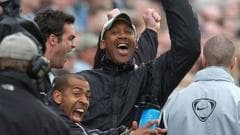
Keith Alexander (second from right, facing camera) won praise for uniting the dressing room
Simon Weaver joined Lincoln City in the summer of 2002 after previously playing under Alexander at Ilkeston.
He recalls his former boss's great ability to unite a dressing room.
One moment that sticks in his memory is the first time he was invited for a training session at Ilkeston.
"I played quite well in training – afterwards I went and knocked on his [office] and he was sat there with his feet up and a bunch of grapes."
Weaver was asked to "just come and play" for the team on Saturday.
"He was just so relaxed," he recalls. "He just made me feel at ease, saying just come and do you what you did [in training].
"We played away first game and won – I got a black eye and I'm thinking, 'I'm liking this, this is my cup of tea'."
England players wearing black armbands at Wembley following Alexander's death in 2010
Alexander was managing Macclesfield when he died in 2010 after falling ill after a game. He was 53.
Tributes poured in from across football, with clubs across the country observing a minute's silence.
At the time, his son Paul described him as "a very humble man", adding: "He didn't realise the impact he had on others just by walking into a room."
In recent years, players who have received the Keith Alexander Award from the Football Black List have included Yaya Toure, Shaka Hislop and Kerry Davis, the first black woman to play for the England women's national team.
His legacy also lives on through the Sacred Sports Foundation, which he founded in St Lucia to help young people through sport.
Mann says Alexander will be remembered for the opportunities he created for others and his willingness to challenge racism in football – and that should never be forgotten.
CORRECTION, 5 October 2026: An earlier version of this article suggested Alexander died after falling ill at a game. He actually fell ill at home after the game.
Listen to highlights from Lincolnshire on BBC Sounds, watch the latest episode of Look North.
Download the BBC News app from the App Store, external for iPhone and iPad or Google Play, external for Android devices
'Quiet, steady, thoughtful' - promotion the Lincoln City way
Fans look back to the future as club begins new era
Byfield to keep knocking on door for black bosses
Kaynak: BBC · Özgün metin İngilizcedir.